
Radar detectors have one job, and they do it in one narrow lane: they hear the radar gun pointed at you, and nothing else. An unmarked Dodge Charger sitting on the shoulder with its radar off is invisible to a pricey box on your windshield.
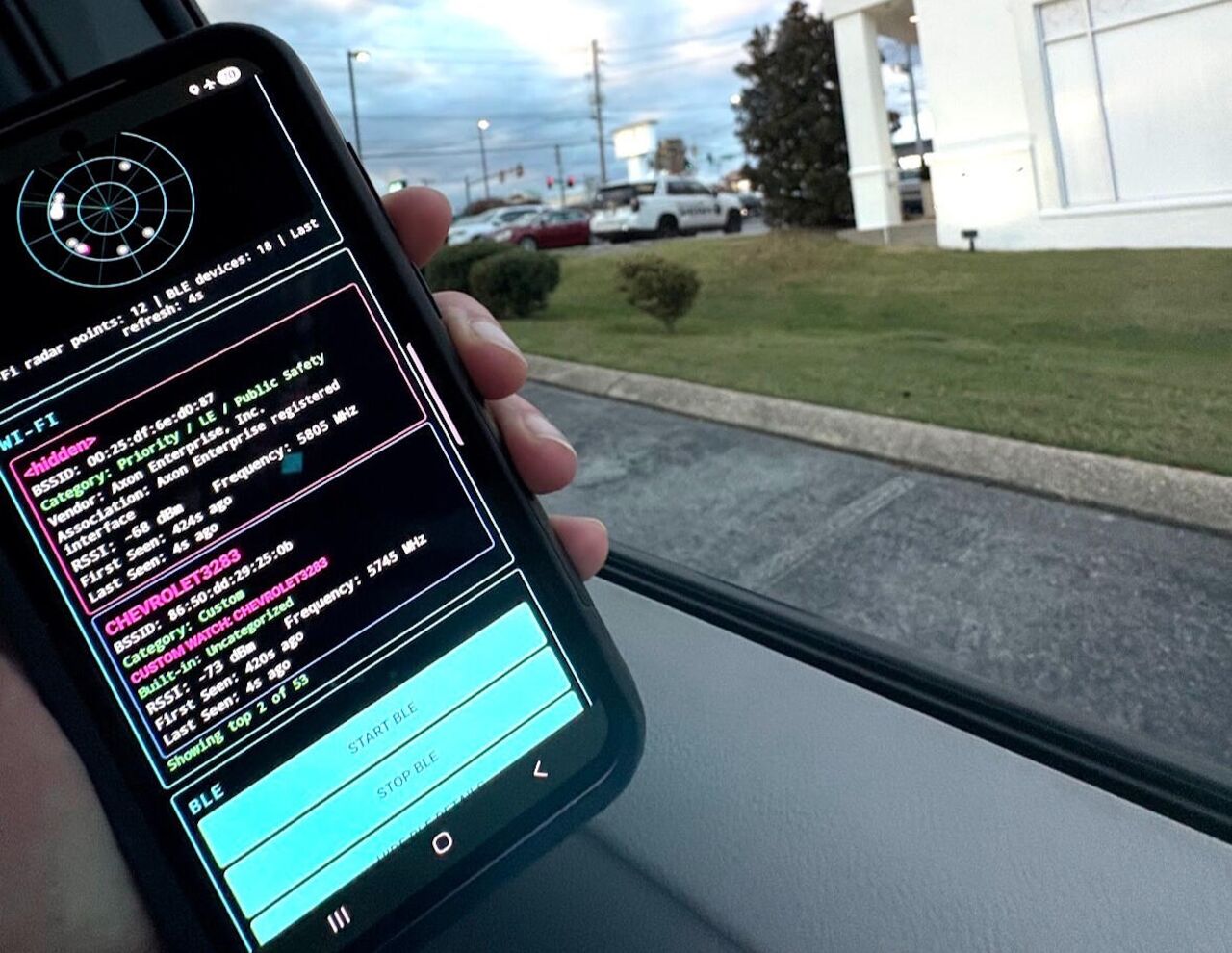
That is the gap a new Android app called SØPHIA is built to fill, and it does it by listening for the electronic noise a modern police car cannot help making.
A modern police car is a rolling IT closet. The body cameras, dash cameras, onboard routers, laptops, and fleet telematics all need to reach one another, along with every dock and gateway wiring the whole kit together. A lot of that gear broadcasts over Bluetooth and Wi-Fi to pair with everything else on board. A plain-looking Charger reads no different from any other on the outside. What it has a harder time hiding is that it is broadcasting like a small office network on wheels.
That is the idea behind SØPHIA, an Android app the developer pitches as a "wireless awareness tool." It taps your phone's built-in Wi-Fi and Bluetooth radios to track nearby wireless activity in real time, matching the signals it picks up against known identifiers. Think of it as a radar built for anything that puts out a signal rather than for radar itself.
The core of the app is live observation. It shows nearby Wi-Fi networks and Bluetooth devices as you move, and its built-in classifications tag the equipment and infrastructure it recognizes. That means you get labeled results rather than raw signal data to puzzle over.
You can file identifiers, network names, or keywords on a Watchlist, then get visual and optional audio alerts when any of them turn up again. That is the feature that turns it from a curiosity into something you could glance at from the driver's seat. You can also silence signals you would rather not be alerted to. And you can send observations out as CSV or JSON, or build what the developer calls an AI Debrief for deeper analysis.
According to the developer, core scanning and classification happen on the device. It runs without an account, a SIM card, a cellular plan, a camera, a microphone, or an AI API key. There is no root access and no extra hardware involved, which lowers the barrier compared to the command-line scanner crowd.
The honest limitations come straight from the developer. "SØPHIA observes wireless information available to your phone. Some drones, cameras, vehicles, and other equipment may be observable when they emit supported signals within range. Not every device broadcasts a detectable signal."
And a match is not a confession: "A signal or manufacturer match is context, not proof of who owns a device or what it's being used for. SØPHIA does not read private messages or pinpoint a transmitter's location." So this is a probabilistic tool. It tells you a cluster of police-flavored electronics is somewhere nearby, not that the sedan two cars ahead is definitely a cop.
For spotting police cars, it works best as a companion to a radar detector, flagging the gear that a radar detector will never hear. The one hardware-level catch: it is Android only. iPhone owners are out, because the app does not directly scan on iOS.
The thing to understand before you buy anything: no phone, SØPHIA included, has radar receiver hardware. Your phone cannot detect an active police radar gun or laser, full stop. SØPHIA sidesteps that by listening for Wi-Fi and Bluetooth instead of radar, which is a different signal entirely. But if what you want is a warning the moment a trooper paints your car with a Ka-band gun, you need a dedicated detector.
For active radar and laser, the current top hardware picks are the Uniden R8, the Valentine One V1 Gen2, and the Escort MAX 360c MKII. The Uniden R8 is a detector that runs on 12 volts and carries a one-year warranty, with a compact footprint around 4.9 inches long and 1.5 inches tall. It lands at roughly $775 to $800. The Valentine One V1 Gen2 sits in the same price neighborhood, around $800, in a similarly small package, 4.6 inches long and about an inch tall.
The Escort MAX 360c MKII is the value play of the three at roughly $575 to $600, measuring 5.15 by 1.38 by 3.25 inches and weighing about two-thirds of a pound, with a one-year warranty and a 2022 release. Any of the three handles the job SØPHIA structurally cannot: detecting live radar and laser enforcement in the moment. That table applies to the Uniden R8 and the Valentine One V1 Gen2, which share that upper price band. The Escort MAX 360c MKII does the same radar-and-laser job for less, which is its argument.
There is a whole class of speed enforcement that neither a wireless scanner nor a radar detector addresses: fixed speed cameras and red light cameras. Those do not use radar at all. Because they emit no radar signal, a radar detector stays silent, with nothing for it to pick up.
The tool that beats hardware here is a GPS app with a camera-location database. It knows where every fixed camera sits and warns you a set distance ahead of each one, every pass, with no false alarms. Against fixed cameras, that method does more than a $400 detector that is physically blind to them. The Radarbot app has topped 10 million downloads and holds the deepest global camera database of any dedicated alert app. It maps cameras, reads out distance over audio, and adds speed limit warnings.
The free version works but leans heavily on ads. Paying for the premium subscription strips the ads, enables offline maps, and turns on real-time community alerts. The catch is the recurring cost, and it does not record video, offer parking mode, or back up to the cloud. It is a single-purpose app, and that single purpose is one it does well. Road Soft Speed Camera Radar is the lightweight alternative, mixing fixed camera data with community reports behind a clean interface that lays out your current speed, the posted limit, and the cameras coming up.
Alerts can be set by distance and type, and it keeps running in the background with audio warnings. Its camera data runs thinner than Radarbot's, especially for newer types such as Flock Safety plate readers, and coverage is stronger in Europe than the U.S. The free version serves frequent ads. Pick it if you want simple and lightweight over comprehensive.
DriveSight takes the camera-alert concept and bolts it onto a full dashcam, which none of the others here do. Its camera database covers 336,000-plus spots nationwide, covering fixed speed and red light cameras along with Flock Safety ALPR readers and police surveillance cameras, with audio warnings, vibration, street names, and exact distance. The free tier gives you the dashcam on its own, recording continuously with parking mode, crash detection, cloud backup, and AI object spotting. The paid Pro tier unlocks the camera database.
If you want one app with the broadest reach that also records your drive, this is the one. Fixed cameras sit still, but patrol cars move, and a static database cannot tell you where a cruiser parked 20 minutes ago. That is where Waze earns its spot. It is a navigation app, not a detector, but its community flags police spots, speed traps, and road hazards as they happen. When one user taps to mark a police car, every driver behind them gets the warning, and on busy roads with a big crowd active, those reports land fast.
The limits are real. Waze has no fixed camera database, since permanent cameras do not get community-reported the way a parked cruiser does. It needs a constant data connection, so no signal means no alerts, and running full navigation drains the battery. Most people already have it installed, and it is free, so the smart move is to run it beside a dedicated camera app for the permanent cameras.
Escort Live rounds things out as a companion app for Escort's hardware detectors, though it runs standalone too. It joins a small fixed camera database to crowd-sourced warnings drawn from Escort's base of hardware owners, so when one of those detectors hits radar, the alert propagates to others nearby. As a standalone, it is a weaker value, carrying a thinner camera database and a smaller crowd of community users than the alternatives above. The payoff comes when you already own Escort hardware and want the crowd-sourced radar sharing.
SØPHIA exists because police gear broadcasts constantly. Worth knowing: the same physics cuts both ways. A product called SignalTrace, marketed to police, is built to read the Bluetooth, Wi-Fi, and RFID signals emitted by electronics in passing cars. That would hand police a way to follow a vehicle by the electronics inside it, alongside license-plate camera data.
One Maryland police department has the tool in trials, and another says it means to deploy it. On legality, radar detectors are banned only in Virginia and Washington, DC, plus in commercial vehicles nationwide. It is uncertain whether those rules would stretch to an app that detects no radar, like SØPHIA. Apps that use GPS to flag camera locations are legal across every U.S. state, because the camera locations they surface are public information.
The thing most likely to land you in trouble is handling your phone while driving, so mount it and leave it alone, and it is worth checking your own state's distracted-driving rules before you lean on any of this. If you want to watch the watchers the way a radar detector cannot, start with SØPHIA on an Android phone, and run it as a supplement rather than a standalone solution.
For the active radar and laser it cannot see, add the Escort MAX 360c MKII if you want to keep the spend nearer $600, or step up to the Uniden R8 or Valentine One V1 Gen2 around $775 to $800. For fixed cameras, layer in DriveSight if you also want a dashcam, or Radarbot if you only want the alerts, with Road Soft Speed Camera Radar as the lighter option. Keep Waze running for live community police reports, and reach for Escort Live mainly if you already own Escort hardware. No single tool covers the whole field, which is exactly why the serious approach is to stack a few.
[Images: SØPHIA, Uniden, Valentine, Escort]
Become a TTAC insider. Get the latest news, features, TTAC takes, and everything else that gets to the truth about cars first by subscribing to our newsletter.