
It's a beautiful summer day in a quiet seaside community. People are flocking to the water to enjoy the ocean breeze, splashing waves, shining sun, and the sound of gulls. However, beneath the waters, something monstrous lurks. A creature never seen before which defies logic and instills fear into all who see it. What's first dismissed as a fisherman's tale is later seen by hundreds of people, and hysteria breaks out. Experts from all over the region arrive trying to make sense of the situation in an attempt to try and restore a sense of order and normalcy. What sounds very similar to the plot of the novel and movie Jaws, was indeed a very real-life phenomena which gripped the town of Gloucester, Massachusetts in the early 1800s. However, instead of a man-eating shark, the creature that haunted Gloucester's shores was a terrifying sea serpent.
Stories of sea serpents have existed ever since humanity began sailing and exploring the seas. After all, the oceans being as vast and perilous as they are, it only made sense to early seafarers that monsters would live there eager to take the lives of sailors and navigators. Monsters in mythology such as Leviathan, Hydra, and Scylla have taught mariners for generations to be both careful and respectful of the high seas. By the start of the 19th century, sea serpents and other fantastical monsters were often dismissed as fables that once filled the edges of maps. However, things would change dramatically in the summer of 1817 with the sighting of America's first sea monster.
It began on August 6, 1817, when two women and a fisherman sighted an unusual creature in a harbor; a dark serpentine like animal around 60 feet long with large humps along its back and the head of a turtle. At first, not much mention was made of the creature but four days later, it was sighted again by another mariner named Amos Story who was able to observe the creature for over an hour and make detailed observations. That same day a woman named Lydia Wonson also saw something unusual in the water which matched exactly with the depiction of Amos Story. Soon afterwards, the serpent was sighted regularly off the harbor with hundreds of spectators lining the shores hoping to catch a glimpse, and they were not disappointed. Some witnesses claim they saw two serpents "dancing" in the water; some saw a 12-inch horn protruding from its head; some allegedly saw the serpent on the shore resting before darting back into the ocean.
Most were filled with awe and fascination at seeing such a creature, but others were alarmed and horrified. The 1810s had been a very difficult time for New England. The War of 1812 had a terrible impact on the shipping industry and 1816 was infamously dubbed "The Year without a Summer" due to unusually cold temperatures including snow in July caused by the eruption of Mount Tambora in 1815 in Indonesia which is widely regarded as the largest volcanic eruption in recorded history. Volcanic ash and dust lingered throughout the sky for over a year, creating a foreboding and ominous atmosphere which caused devastation to crops and agriculture. The sudden appearance of a sea serpent was interpreted by some as a divine symbol and approaching apocalyptic calamity as an unholy creature had seemingly leapt from the pages of the Bible into the ocean.
Excitement soon turned into hysteria with multiple fishermen and sailors who sighted the creature trying to kill it but with no avail. In order to make sense of the situation, the Linnaean Society of New England was sent to Gloucester to investigate the sightings and interview witnesses. On September 27, 1817, a local resident named Gorham Norwood killed a small black snake on the beach which allegedly had the same unusual spine characteristics as the sea serpent. Residents were certain it was an offspring of the serpent and based on this specimen along with testimonies from witnesses, the Linnaean Society concluded the serpent was a new species and named it Scoliophis atlanticus (Atlantic Humped-Snake) in November 1817.
Sightings of the serpent would continue throughout 1818-1819 expanding beyond Gloucester to all over the northeast but by 1820, the creature had suddenly disappeared, leaving behind lots of fantastical tales and mysterious unanswered questions. Other members of the scientific community began to investigate the sea serpent including French naturalist Charles Alexandre Lesueur who discovered the Linnaean Society made an enormous error. The snake Norwood killed wasn't a new species, it was simply a common Eastern racer snake which had a spinal deformity. The story became a huge embarrassment for the Society with news spreading as far as South Carolina with Charleston playwright William Crafts writing a satirical play titled The sea serpent; or, Gloucester hoax: A dramatic jeu d'esprit, in three acts. Decades later in the 1860s, the Boston Society of Natural History reexamined the preserved remains of the offspring and officially debunked it attributing the misidentification to mass hysteria.
Although the infant of Scoliophis atlanticus turned out to be nonexistent, the big question still remains over two centuries later; what did people see in Gloucester harbor during those chaotic years? The Boston Society of Natural History believes the sightings were caused by humpback whales feeding at the surface and rolling over creating an illusion of a serpentine creature. In 2019, The Skeptical Inquirer magazine concluded it was a pod of narwhals that had drifted south from the Arctic due to the colder temperatures and would explain the large horn allegedly seen on the serpent's head. In 2023, Fate magazine theorized the serpent might've been a Sperm whale with a stuck harpoon and overturned rowboat that had gathered lots of debris stretching hundreds of feet and appearing like a serpent to all who saw it. Or perhaps maybe the serpent was a new undiscovered animal such as a large eel which lurks in the deepest darkest depths of the ocean and has yet to be officially seen and embraced by science.
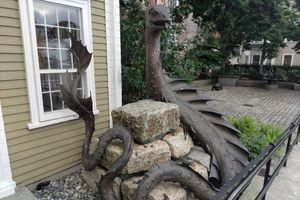
Whatever the creature might've been, it's undeniable the impact it had on the local culture and folklore of Gloucester. Murals and artwork of the serpent can be seen in many places and in 2019, the Cape Ann Museum installed a large bronze statue of the serpent right outside the main entrance which is popular with many visitors. There are some exhibits about the serpent inside the museum, and the creature is also mentioned on the self-guided tour of the city called the Gloucester Harborwalk. If you're interested in cryptids and maritime history, the Cape Ann Museum along with the City of Gloucester is certainly worth a visit and while you're there, keep an eye out on the harbor for maybe one day, the serpent may return and fascinate us once again.